
New publication in PLOS Medicine
Pandemic influenza begins when a new influenza virus emerges, spreads efficiently between people, and encounters a population with little pre-existing immunity. Unlike seasonal influenza, the timing, transmissibility, and severity of the next pandemic strain are unknown. A strain-matched vaccine can become the central preventive tool only after the virus has been identified and vaccine production has begun, leaving a critical interval in which health systems must limit illness and preserve their ability to provide care.
Current preparedness plans therefore combine surveillance, vaccine-development and distribution plans, temporary public-health measures, and advance purchases of antiviral drugs. These national stockpiles are reserves of treatment courses—most commonly drugs such as oseltamivir—held so that symptomatic patients can be treated early. Many high-income countries have planned reserves sufficient to cover roughly 25% of their population. The stockpile is intended to reduce severe disease and hospitalizations and to bridge the period until vaccines become widely available.
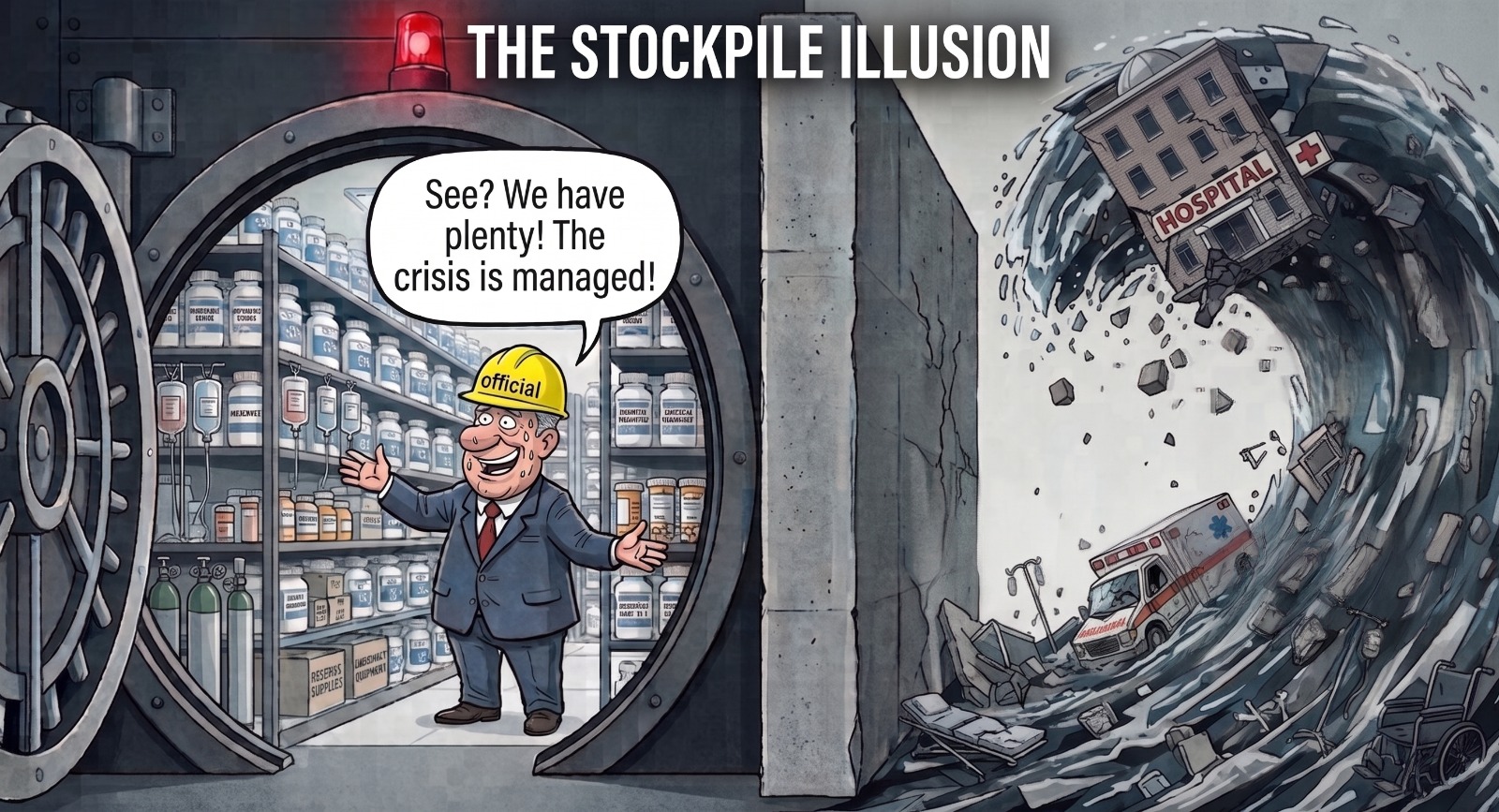
The stockpile illusion
Our central finding is that massive antiviral stockpiles can offer a false sense of security. They can substantially reduce hospital demand during a moderate pandemic, but they cannot by themselves protect the healthcare system during a severe event. Even under the optimistic assumption that every symptomatic patient receives treatment immediately and that the drugs strongly reduce hospitalization, the resulting surge can still exceed available hospital capacity by several-fold.
To establish this result, Amit Huppert and I combine a static lower-bound calculation, a dynamic epidemic model, and reconstructions of the 1918, 1957, and 1968 influenza pandemics. We compare projected daily hospital demand with the number of staffed beds that health systems can make available. This shifts the planning question from how many treatment courses a country owns to whether those treatments can keep the daily patient surge within the capacity of the healthcare system.
The results support a capacity-based preparedness strategy: targeted antiviral reserves remain useful, but they should be integrated with temporary interventions and flexible models of care that can preserve hospital capacity until vaccines become available.
These findings warrant a timely reevaluation of pandemic preparedness policy: massive antiviral stockpiles are now approaching expiration in countries around the world, creating a natural decision point for replacing inventory-based targets with capacity-based plans.
Read the open-access article in PLOS Medicine
Gavish N, Huppert A. Transforming pandemic influenza antiviral stockpiling using a capacity-based approach: A modeling study. PLOS Medicine 23(11): e1004992 (2026).